
Crab Island Destin Guide: The Complete First-Timer’s Guide
Crab Island is the first thing most first-time visitors ask us about, and it is also the most misunderstood place in Destin. This Crab Island Destin guide covers what it actually is, how to get there, when the water looks like the photos, what to bring, and the safety basics nobody should skip. Read it once before you book a boat and you will have a far better day than the visitors who just show up and hope for the best.
What Crab Island Actually Is
First, the name lies. Crab Island is not an island. It is a large submerged sandbar in Choctawhatchee Bay, just north of the Marler Bridge (US-98) at the southern entrance of the bay, inside Destin’s East Pass. There is no land above the water, no dock, no beach to walk to, and no road of any kind. You stand on sand under one to four feet of water, surrounded by boats, with the Gulf on one side and the bay on the other.
That is the whole appeal. On a good day, the water over the sandbar is waist-deep, warm, and so clear and green that it looks Photoshopped. Hundreds of boats anchor there on summer weekends and everyone just wades, floats, and hangs out. It is part swimming hole, part floating block party, and part picnic, and there is nothing else quite like it on the Gulf Coast.

One honest note on timing: this guide lands in November, and November is not Crab Island season. The water is cold, the vendors are gone, and tour boats run far less often. The guide below is written for planning your trip, and the best months to actually go are May through August, with May and September to early October as the warm-water, lower-crowd sweet spots. If you are visiting Destin this winter, our Destin in winter guide covers what is actually good right now.
Tides and Timing: The Crab Island Destin Guide to Clear Water
The tide is the whole game at Crab Island. High, incoming tide pushes clear emerald Gulf water into the bay, and that is when the sandbar matches the photos. Plan to arrive within one to two hours of high tide, with right before high tide as the sweet spot. Low tide is shallower and murkier, because bay water and stirred sediment cloud the view.
High tide shifts about 50 minutes later each day, so check the NOAA tide predictions for Destin for your exact date before you go. Do not trust a tide time from a blog post, including this one. Midday sun on the white sand helps the color most, so a high tide that lands late morning is the best draw of all.
Mornings are the other half of good timing. The best window is roughly 9 AM to noon: calmer water, less wind, thinner crowds, and easier anchoring. Wind builds through the afternoon, and summer pop-up storms often arrive by mid-afternoon, so plan to be heading back before the sky turns. Afternoons, especially Saturdays, are the lively party scene, which is fun if that is what you want and the wrong choice if it is not.
The season matters as much as the tide. The sandbar is busiest from Memorial Day through Labor Day, with peak vendor activity and the warmest water from June to August. May and September to early October are the sweet spot: warm water, far fewer boats, and vendors still operating on weekends. In winter, you can still get out there by charter on a mild day, and the emerald color and the dolphins are still there, but the water is too cold to swim for most people.
The Three Ways to Get There
Crab Island is boat only. There is no driving, walking, or swimming across: the current in the channel is strong and the boat traffic is heavy. Most rentals and tours depart from Destin Harbor and HarborWalk Village, which is about 2.5 miles from our stays, under five minutes by car. Here are the three realistic options, in order of how much work they ask of you.
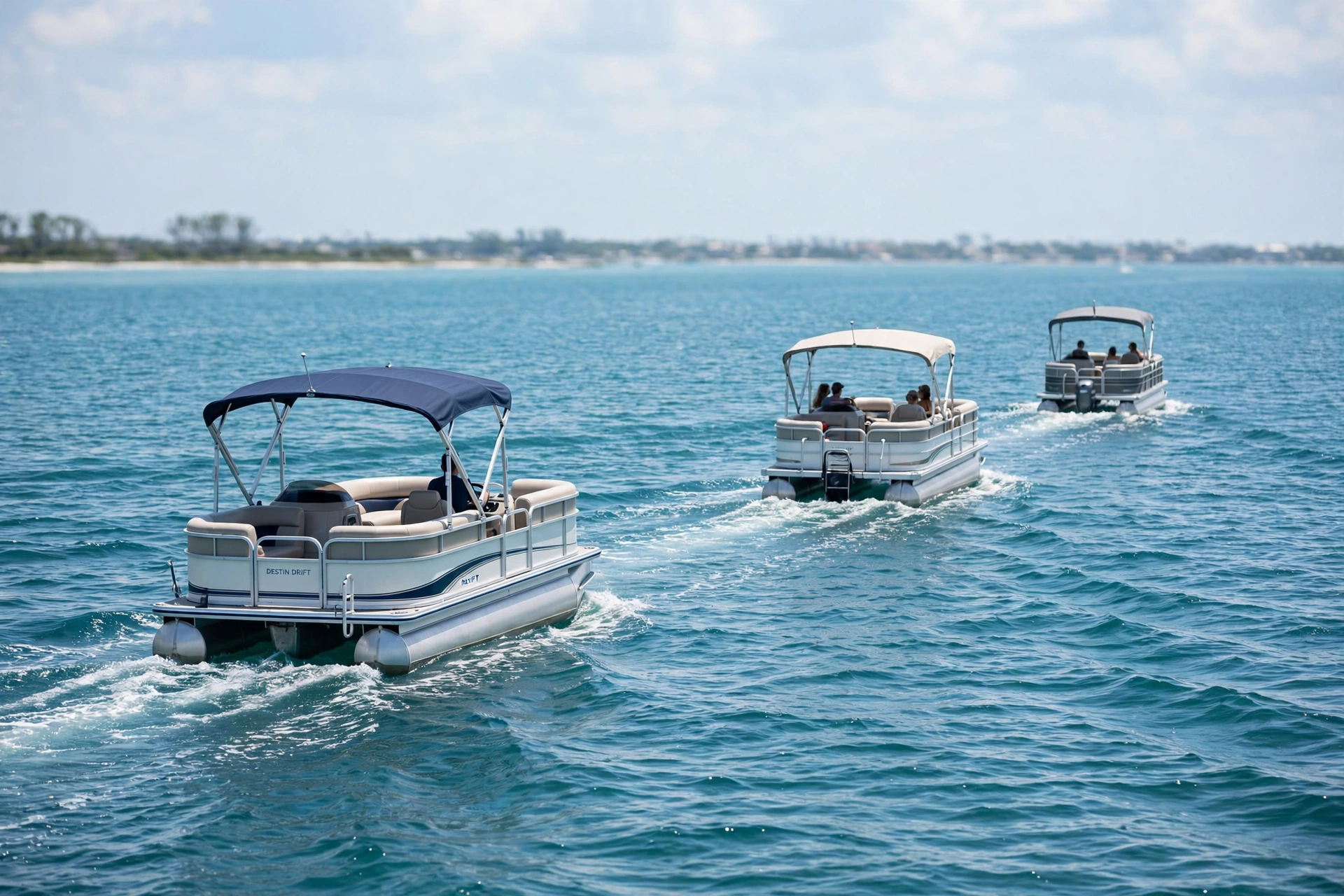
1. A shared Crab Island tour. The easiest option for most first-timers, and the one we recommend if you have never been. A Crab Island tour handles the boat, the route, the anchoring, and usually floats and snorkel gear, and a typical visit runs about three hours. You show up, step on, and step off into waist-deep water. No boating experience, no navigation, no worrying about the tide while you are supposed to be relaxing.
2. A captained private pontoon. The middle option, and the best one for families and groups. You get a private boat and a captain who knows the tides, the traffic, and where to anchor, while your group gets the run of the boat. Look for a captain with a USCG Master Captain’s license. Private captained pontoons usually run three to four hours for groups of up to ten or twelve, and the per-person cost drops fast once you split it.
3. A self-drive pontoon rental. The most popular option for confident groups, and the most freedom. Pontoon boat rentals seat ten to twelve people on a standard boat, and a full day gives you Crab Island in the morning and a slow cruise of the harbor and bay in the afternoon. A few things to know before you take the wheel: in Florida, anyone born on or after January 1, 1988 needs a Boating Safety Education ID card or a temporary certificate to operate a boat of 10 horsepower or more, and rental companies will brief you and hand you a map, but a briefing is not local knowledge of tides, currents, or traffic. Stay in the marked channels until the sandbar, trim the motor up as the bottom rises fast, and do not exceed the capacity plate on the boat.
Two more ways exist, with honest limits. A water taxi or shuttle boat runs from Destin Harbor, near AJ’s Seafood and Oyster Bar and Dewey Destin’s, for roughly $10 to $15 per person round trip, and the ride takes ten to fifteen minutes, but you are on the shuttle’s schedule, not your own. Jet skis and paddleboards can get you there, but only for experienced riders and paddlers: the tide can make paddling back hard, and a jet ski is a poor place for a cooler, kids, or a long stay. Guided jet ski tours are the safer version if you want the speed without the navigation.
What to Bring: Pack Like There Is Nothing There

Because there is nothing there. No restrooms, no shade, no trash cans, no lifeguards, and no admission fee or reserved spots. Pack everything you want and pack everything out, and you will be fine. Here is the list that covers it:
- A cooler with water and food. Water first, more than you think you need, plus sandwiches, fruit, and snacks. The sun reflects off the water and doubles your exposure, so you will drink more than you expect.
- Sunscreen, hats, and sunglasses. Reapply often. There is no shade on a sandbar.
- Water shoes. The sand is soft, but shells and the odd sharp edge are not.
- Floats. A noodle or a float is the difference between standing all day and actually relaxing.
- Towels and a dry bag. For phones, keys, and anything else that cannot get wet.
- Cash and a card. Some vendors are cash only, and cards are useless if your phone is in a dry bag at the bottom of the cooler.
- Life jackets for kids and weak swimmers. Boats must carry one for everyone on board, and children under six must wear one while underway on boats under 26 feet.
Leave the glass at home. Pack cans and plastic only. And if you bring alcohol, bring your own and keep it in cans: you may drink your own on the water if you are 21 or older, but no alcohol is sold on the sandbar, and Florida’s boating under the influence limit is 0.08, the same as driving. FWC and marine patrol enforce it, especially on weekends, so designate a sober captain before anyone opens a cooler.
Floating Vendors: What Is Actually There Now
Set expectations here, because the old stories are out of date. The big inflatable water park closed after 2020, the large floating restaurants are gone, and only a small number of permitted vendor boats remain. The long-term plan is to phase commercial vendors out entirely, so what is there keeps shrinking.
On peak summer weekends, expect a handful of small permitted food boats selling tacos, burgers, barbecue, and ice cream, plus non-alcoholic frozen drinks, with food plates roughly $10 to $14. On a weekday, or outside May to early September, expect none at all. Bring a cooler with everything you want and treat any vendor you find as a bonus, not a plan.
Crab Island With Kids

Crab Island is generally good for kids, with two conditions: life jackets and close supervision. The shallow water at high tide is perfect for little ones who can stand and splash, and the sandbar is big enough that families can claim a quiet corner away from the party boats. Low tide is more forgiving depth-wise but murkier, so high tide is still the better call for families.
Keep kids well away from the sandbar edges, where the bottom drops off fast and the current runs. That is the rule for adults too, but kids wander, so pick your anchor spot in the middle of the shallow area and stay there. Mornings are the family window: calmer, quieter, and easier to watch everyone at once.
If you are planning the whole trip with kids in mind, our itinerary guide puts a Crab Island morning on day two, when everyone is settled in and still excited.
Safety: Read This Before You Wade In
Crab Island is safe when you respect it and dangerous when you do not, and the danger is not obvious because the water looks so friendly. The edges of the sandbar drop off into deep water with a strong current, especially near the bridge, the jetties, and the channels, and the outgoing tide through East Pass can create a current even a strong swimmer cannot fight. Standing in knee-deep water can turn dangerous within a couple of hours as the tide shifts.
The rules are simple. Stay in the shallow middle. Do not wade past the sandbar edge. Do not swim to or from shore, and do not let kids near the drop-offs. Watch the weather, because summer storms build fast and there is no shelter on a sandbar, so head in early when the sky turns. There are no lifeguards anywhere on the sandbar, so you are your own safety net. And if you are driving a rental boat, the sober captain rule is not a suggestion.
What It Costs (Approximate, 2026)
Prices change with the season and the operator, so treat these as planning numbers, not quotes. Self-drive pontoon rentals run roughly $130 to $180 for two hours, $280 to $380 for a half day, and $450 to $650 for a full day, and they are typically 15 to 25 percent cheaper in May and September to October than in June to August. A shared captained three-hour tour runs about $75 per person, and a private captained pontoon runs about $339 to $550 per group for three to four hours. Captain hire is sometimes separate, about $30 an hour. Book summer trips a few days ahead at least, and a week ahead around holidays, because the popular slots sell out. Our Destin on the Water guide covers the rest of the water activities worth booking in the same trip, and our fishing charter links cover the morning-boat-to-dinner-table loop that pairs so well with a Crab Island day.
A Simple First-Timer’s Plan
Here is the version of the day we would give a friend:
- Check the tide chart the night before. Pick a morning with high tide landing between 9 AM and noon, and book the boat for that window.
- Pack the cooler the night before. Water, sandwiches, fruit, sunscreen, towels, floats, and a dry bag, all ready to carry onto the boat.
- Arrive at the harbor early. The harbor is minutes from our stays, and an early departure means calm water and an easy anchor spot.
- Anchor in the middle, stay in the middle. Wade, float, snack, and watch the boats. Save the exploring for the edges of the sandbar in your imagination.
- Head in before the afternoon wind and storms. Back at the condo by early afternoon, rinse off, and spend the evening at the harbor. If you want dinner out, our restaurant guide covers where to go, and our seafood guide covers what to order when you get there.
If you are still deciding whether Destin is the right trip at all, our honest answer is in Is Destin Worth Visiting? Crab Island is one of the reasons the answer is yes, as long as you go at the right tide, on the right boat, with the right cooler.
Plan It From a Home Base Minutes From the Harbor
Crab Island is a morning, not a whole vacation, and the rest of the day is easier when the harbor is minutes away. Our Pelican Beach Resort condos and the Southbay Townhouse are about 2.5 miles from Destin Harbor, under five minutes by car, so the cooler gets packed in a full kitchen, the boat leaves from the harbor down the road, and the rinse-off shower is waiting when you get back. Book direct at destindrift.com/#stays and you get the same homes you would find on Airbnb or Vrbo, with no platform guest fees and a host who will point you to the right boat. Follow @destindriftstays on Instagram for harbor mornings, Gulf sunsets, and a look inside the stays.
Disclosure: Some links in this post are affiliate links. If you book through them, we may earn a small commission at no extra cost to you.